
This release of OmniVista Cirrus is available as a free trial or paid version of the full OmniVista Cirrus Solution. The trial version extends for 90 days and can be used to monitor up to 20 Access Point and Switch devices combined (additional time and number of devices can be requested). You can then upgrade from the free trial version to a paid licensed version of OmniVista Cirrus.
OmniVista Cirrus 10.6.1 (OVC 10.6.1) provides an elastic cloud scale platform supporting dynamic expansion, ensuring high availability and resilience. You can access OVC 10.6.1 from anywhere using any approved browser and device (e.g., workstation, tablet). Access to OmniVista Cirrus is supported on the following browsers: Chrome 79+ (on Windows and Redhat/SuSE Linux client PCs), and Firefox 62+ (on Windows and Redhat/SuSE Linux client PCs).
These Production Notes detail features and enhancements, network/device configuration prerequisites, supported devices, and known issues/workarounds in OmniVista Cirrus 10.6.1. Please read the Production Notes in their entirety as they contain important operational information that may impact successful use of the application.
New in This Release
The following sections provide an overview of the features and enhancements introduced with this release.
New Devices Supported
Stellar Access Points
The following Wi-Fi Gen 7 OmniAccess Stellar Access Points are now supported:
-
OAW-AP1541
-
OAW-AP1542
-
OAW-AP1501S
AOS Switches
The following AOS switch models are now supported:
-
OS6370
-
OS6870-U32
-
Legacy AOS 6 models supported: OS6350, OS6450
See the Supported Devices section below for a list of all devices currently supported in OmniVista Cirrus 10.6.1.
Software Supported
-
AWOS 5.0.5 - OmniVista Cirrus 10.6.1 supports AWOS 5.0.5 on all supported Access Points.
AOS 8.9R4 is the minimum software version supported by OmniVista Cirrus. AOS software versions below 8.9R4 are not supported.
-
AOS 6.7.2.222.R08 - OmniVista Cirrus 10.6.1 supports AOS 6.7.2.222.R08 on the OS6350 and OS6450 switch models.
-
AOS 8.11.R01 - OmniVista Cirrus 10.6.1 supports AOS 8.11R01 on all supported AOS Switches, except for the OS6900-T20/T40/X20/X40/X72/Q32 models, which do not support AOS 8.10R1 or later versions.
-
OS6360, OS6465, OS6560, and OS6570M switches require a U-boot update to version 8.11R1 (or later) before you can update the switch to AOS 8.11R1 (or later). Failing to update U-boot will cause boot failure.
-
OmniVista supports U-Boot upgrades; however, you must perform the U-Boot upgrade before setting the Desired Software Version to 8.11.R1 to avoid onboarding and network issues.
-
For all other switch models, a U-Boot upgrade is not mandatory but is recommended. Refer to the AOS release notes for details.
-
To check the U-Boot version on a switch, select the switch in the Device Inventory, click the Additional Information icon, and locate the U-Boot version in the Modules section. Alternatively, you can run the show hardware-info CLI command on the switch.
-
Modifying the default password of “admin” user is strongly recommended for all switches. Changing the password is a mandatory requirement for AOS versions 8.10.R04 and above.
-
If the default credentials have not yet been changed on the switch, you must set the new password on switches through the Management User Template by either creating a new template or editing an existing template. Otherwise, the switch will fail to onboard in OmniVista.
-
For switches running AOS 8.10.R03 or earlier, changing the default password is not mandatory but is strongly recommended.
New Features and Functions
This section details the following General Availability (GA) features introduced in this release. These features completed the full validation cycle and are officially supported in OmniVista Cirrus 10.6.1.
OmniVista Advisor Edge
Advisor Edge extends OmniVista Cirrus functionality with advanced anomaly detection and alert routing capabilities. This feature allows Organization Administrators to declare Advisor Edge instances, associate Organization devices for monitoring, manage anomalies, and route alerts to Rainbow communication bubbles. Advisor Edge is available for users with an active OmniVista subscription or trial license on non-Lite plans.
-
-
Using the OmniVista Advisor Edge interface requires interaction with an OmniVista Network Advisor (OVNA) installation. The following options are available to accommodate this requirement:
-
Standalone OVNA - During the standalone installation process you are asked if you want to use OmniVista Cirrus or Terra for management, select “Yes”. This allows you to declare the standalone OVNA installation as an Advisor Edge instance in the OmniVista Advisor Edge application.
-
OVNA Edge - An OVNA installation that you can add in Edge mode to your OmniVista Terra appliance. You can declare the OVNA Edge installation as an Advisor Edge instance in the OmniVista Advisor Edge application, in the same way you would declare a standalone OVNA. See the OmniVista Advisor Edge and Configuring OVNA Edge sections in the OmniVista Terra online help for more information
-
Note that if you select this option, the following prerequisites apply:
-
OVNA Edge is supported only on 1 VM.
-
If OVNA Edge is installed on 1 VM, installing Network Services on that same VM is not supported.
-
-
-
-
OmniVista AIVA (AI Assistant)
AIVA is an AI-powered network management assistant embedded directly in OmniVista Cirrus. Ask questions in plain language and receive instant, formatted answers about your network—including infrastructure summaries, health reports, configuration guidance, and active alerts. AIVA reduces the time you spend navigating between screens by bringing key network insights into a single conversational interface. Only OmniVista Cirrus supports AIVA in this release..
-
AIVA automatically detects the language of your question and responds in the same language. No configuration is required—simply write your question in your preferred language and AIVA replies accordingly.
-
AIVA integration with Advisor Edge to help network administrators with the following tasks:
-
Creating custom anomaly detections using plain-language descriptions.
-
Delivering AI-powered network alerts directly into Rainbow team bubbles, where you can escalate any anomaly to AIVA for immediate analysis.
-
Authenticated Switch Access Through UPAM
Authenticated Switch Access allows you to use the UPAM local database for switch authentication. This implementation of this feature provides the following functionality:
-
Configuring a single database for both network/switch and client authentication to centralize account management, apply consistent privileges, and monitor successful and failed switch login attempts.
-
Enable or Disable the UPAM local database for ASA and enable or disable an existing Switch User Account.
-
After creating a switch user, create an AAA Server Profile for that user, set UPAM as the server for switch access, and assign the AAA Server Profile to network switches.
Certificate Local Authorization Rules
When an Access Policy uses Local Database as the authentication source and EAP-TLS as the sole authentication method, you can enable Local Authorization to control network access based on the attributes in the client certificate. Local Authorization evaluates administrator-defined rules against the connecting device's certificate and either assigns a specific Access Role Profile or denies access. You can configure access control policies by creating Authorization rules in OmniVista.
CLI Scripting Tool
The CLI Scripting Tool lets you create, manage, and run CLI scripts on network devices across the organization. You can execute scripts immediately or schedule them to run repeatedly. Results consolidate into searchable logs that you can export or email. Organization administrators use the CLI scripting tool to automate device configuration or data collection. This implementation of the CLI Scripting Tool provides the following functionality:
-
CLI Scripts - Create and manage all configured CLI scripts in the organization using this tool.
-
CLI Executions - Manage and view all executions in the organization.
-
Execution Logs - View all execution log entries for all past runs in your organization.
-
Execution Logs Settings - Set the general and email scheduler settings for CLI Automation.
Fleet Supervision Access
Fleet Supervision 2.0 is now accessible from the OmniVista Cirrus UI with the ability to launch Fleet Supervision from the MSP Portal Dashboard. See Fleet Supervision online help for more information.
Legacy OmniSwitch (AOS 6) Support With SNMP
OmniVista Cirrus now provides limited support of Legacy OmniSwitch (AOS 6) devices through the SNMP protocol using standard SNMP MIBs . You can add these devices to the Device Inventory by serial number, assign SNMP credentials through Management User Templates, and control how frequently OmniVista polls them for status updates.
This release of OmniVista Cirrus 10.6.1 supports the following features on switches running AOS 6.x:
|
Device Onboarding |
Scheduled Upgrade |
|
Device Inventory |
Collect Support Info |
|
Device SSH, Labels |
Traps (View) |
|
Topology |
VLAN, IP Interface (View) |
|
Scripts |
Wired Ports (View) |
Legacy OmniSwitch devices are not supported in a Flexible Pay Organization.
OmniVista Lite
Selecting OmniVista Lite when creating an organization activates a Freemium Subscription that provides a basic feature set for managing up to 25 devices. You can upgrade OmniVista Lite to the advanced OmniVista Cirrus platform with a paid subscription.
Shortest Path Bridging (SPB) for L3VPN and VLAN Support
SPB Services on AOS Switches now support L3VPN and VLAN configuration. This implementation of SPB provides the following functionality:
-
VRF Configuration - You can create and manage VRF (Virtual Routing and Forwarding) instances and L3 VPN bindings on SPB-enabled switches. VRF instances segment networks by isolating routing tables, while L3 VPN bindings link VRFs to SPB services for inter-site Layer 3 connectivity. Both IPv4 and IPv6 gateway types are supported.
-
L3VPN - The L3 VPN Configuration feature lets you create and manage L3 VPN bindings on SPB-capable switches. These bindings connect VRFs to SPB services for inter-site Layer 3 connectivity. Both IPv4 and IPv6 gateways are supported.
U-Boot Upgrade
You can now update the U-Boot firmware on your AOS network switches directly from the OmniVista management interface. Use the U-Boot Upgrade screen to upload a U-Boot package, select target switches, and monitor file transfer, installation, and reboot—all in one workflow. This functionality is intended for network administrators managing AOS switch infrastructure to keep U-Boot firmware current across their deployment.
Application Updates/Enhancements
-
Countries of Service for OmniVista Cirrus - You can now select the countries of Singapore and Vietnam to create a 6GHz band RF Profile.
-
CoA/DM from External RADIUS Server - The CoA/DM from External RADIUS server feature enables UPAM to act as a proxy between an External RADIUS server and Network Access Servers (NAS) such as Steller Access Points (APs). When enabled, UPAM replaces the NAS-IP-Address attribute in RADIUS packets with a designated UPAM IP address, allowing the External RADIUS server to send Change of Authorization (CoA) and Disconnect Message (DM) requests back through UPAM. UPAM then forwards these requests to the correct NAS device. This functionality is supported only on Stellar APs.
-
Event Responder Profile Forward Trap Action - This functionality extends the existing Event Responder capability (which already supports email notifications and auto-acknowledgement) by adding a third response action specifically for switch devices. The Forward Trap action automatically forwards SNMP traps from switch devices to an external monitoring system. When a trap matches a responder rule, the application resends it to a specified destination—an IPv4 address, IPv6 address, or fully qualified domain name (FQDN)—with a configurable port number.
-
License Management- The following required licenses are now available for the related OmniVista features and our manageable from the License Management screen:
-
AIVA Credits - AI Credits are an organization-level entitlement that controls team access to the AIVA intelligent assistant. Each interaction with AIVA consumes credits from the Organization's pool. On the AIVA panel and License Management screen you can view the credit balance, see how credits are allocated, and monitor usage across OmniVista Cirrus.
-
Edge Advisor Subscription and License Management - Controls how many network devices your organization can monitor with Advisor Edge instances. The system enforces device-level entitlement: you assign eligible devices to Advisor Edge instances, and each assigned device consumes one entitlement unit from your organization's trial or paid capacity.
-
Legacy OmniSwitch (AOS 6x) - OmniVista supports dedicated paid license categories for managing Legacy OmniSwitch (AOS 6x) devices under a CAPEX subscription.
-
-
Provisioning Configuration - New attributes for provisioning APs:
-
Network Forwarding - You can now provision administrator controls for TCP Segmentation Offload (TSO) and Large Receive Offload (LRO) in the Provisioning Template. TSO and LRO are network forwarding parameters that control how Stellar APs handle TCP packet segmentation and reassembly at the hardware level.
-
Early Availability Features
The following Early Availability (EA) features are available in OmniVista Cirrus 10.6.1 and can be configured. However, they have not gone through the complete validation cycle and are therefore not officially supported.
-
AP Neighbor Information - A new “State” column and filter added to the Neighbor APs List screen. You can filter the AP state by “Active”, “Static Active”, or “Inactive” (“Offline”, Wireless Aging”, “Static Offline”).
-
Standard Power AP Support for 6GHz - Standard power AP models (AP1571, AP1572, AP1561, AP1542) running AWOS 5.0.5 support 6GHz operation.
-
Celona Integration (Phase II) - The following functionality further enhances OmniVista Cirrus integration with the Celona Private Wireless solution:
-
-
OmniVista Cirrus implementation of SAML SSO (Single Sign-On) - Provides the required login to access the Celona Orchestrator.
-
If the same SSO user account is configured for both the Celona Orchestrator and OmniVista Cirrus, users will have seamless access to both systems via single sign-on.
-
Single Sign-On is integrated with Okta and Azure identity Providers to follow the SAML 2.0 protocol authentication.
-
The OmniVista Cirrus SSO access to Celona Orchestrator authenticates users and provides tokens/assertions (like SAML tokens) to the Celona Orchestrator.
-
-
Device Catalog View - OmniVista Cirrus fetches Celona access points on demand from the Celona Orchestrator and displays detailed inventory information in the OmniVista Device Catalog view.
-
Network Topology View - The network topology for Celona access points is shown in the OmniVista Cirrus topology view. Topology is derived from LLDP information provided by the configured switch.
-
Alerts (Rainbow notifications) - Alerts from the Celona Orchestrator are reported in OmniVista Cirrus on the Alerts page. If desired, alerts can also be pushed as Rainbow notification bubbles.
-
-
Manual and API RADIUS-CoA in UPAM - The RADIUS Change of Authorization (CoA) updates a connected wireless client’s access policy without disconnecting the client.
-
A “Trigger CoA Client” action is now available to change the Access Role Profile, Policy List, or session timeout for a client in real time.
-
-
Multi-lingual support - OmniVista supports six display languages across the entire platform interface: English, French, Japanese, Chinese, German, and Spanish. This allows you to work in your preferred language with localized labels, menus, dates, numbers, maps, email templates, and captive portal content.
-
One Month Add-On Sku - Allows partners and organization administrators to purchase and apply license subscriptions with a one-month duration. This supports short-term co-termination extensions that align subscription end dates with monthly budgeting cycles. OmniVista Terra recognizes and processes 1-month license entries alongside existing yearly durations (1-year, 3-year, 5-year, and 10-year).
-
Provisioning Configuration - New attributes for provisioning APs:
-
Client-Context - Information shared between Stellar APs when wireless stations (STAs) roam between access points. This data includes the client's hostname, operating system, device type, and authenticated user identity. Encrypting this exchange prevents client details from being transmitted in plaintext between APs.
-
Encryption - Controls whether client-context data exchanged between APs when roaming is encrypted.
-
Roaming Domain - Defines the roaming group for the AP. Clients can roam only between APs that share the same roaming domain, and only RF neighbors within the same domain are considered for roaming decisions. By default, the Roaming Domain is set to the Organization ID.
-
-
-
SNMP Traps - Automatic Polling support for missed SNMP traps.
-
Wi-Fi Floorplan and Heatmap - Provides real-time visualization of wireless coverage and client density across your buildings and floors. It uses a modern propagation model that supports 2.4 GHz, 5 GHz, and 6 GHz bands, accounting for wall materials and antenna characteristics to deliver accurate coverage predictions. Network administrators responsible for wireless planning and monitoring can use this guide to set up floor plans, analyze coverage gaps, and track client distribution.
Feature Parity Matrix
The following tables in this section provide an overview of OmniVista 10.6.1 parity with OmniVista Cirrus 4.x:
|
|
OVC 4.x |
OV 10.5.1 |
OV 10.5.2 |
OV 10.6.1 |
|
LAN/WLAN Unified Mgmt |
✔ |
✔ |
✔ |
✔ |
|
On Cloud |
✔ OV Cirrus 4 |
✔ OV Cirrus 10 |
✔ |
✔ |
|
On-Premises |
✔ OV 2500 |
✔ OV Terra |
✔ |
✔ |
|
On-Premises L3 High-Availability for LAN+WLAN |
✔ |
✔
|
✔ |
✔ |
|
Fleet Dashboard |
Not Supported |
✔ |
✔ |
✔ |
|
OmniVista Lite |
Not Supported |
Not Supported |
Not Supported |
✔ |
Network Management
|
||||
|
INVENTORY |
|
|
|
|
|
Device Catalog |
✔ |
✔ |
✔ |
✔ |
|
Device License Status |
✔ |
✔ |
✔ |
✔ |
|
Notifications - Alerts / Traps |
✔ |
✔ |
✔ |
✔ |
|
Device Trouble Shooting |
✔ |
✔ |
✔ |
✔ |
|
Scheduled Upgrades |
✔ |
✔ WLAN |
✔ LAN |
✔ |
|
Device Backup/Restore (LAN) |
✔ |
✔ Backup |
✔ Restore |
✔ |
|
Private Firmware upgrade |
Not supported |
✔ |
✔ |
✔ |
|
RBAC - Users & Group |
✔ |
✔ MSP/Org/Site level |
✔ |
✔ |
|
RBAC – Users external source auth |
✔ |
Not supported |
Not supported |
✔ RADIUS (TLS)/ LDAP TLS |
|
PROVISIONING |
|
|
|
|
|
Template based configuration |
✔ |
✔ |
✔ |
✔ |
|
AP groups management |
✔ |
✔ |
✔ |
✔ |
|
Provisioning/password compliance |
Not supported |
✔ |
✔ |
✔ |
|
Bulk configuration |
✔ |
✔ |
✔ |
✔ |
|
Golden configuration |
✔ |
✔ |
✔ |
✔ |
|
Configuration audit |
✔ |
✔ |
✔ |
✔ |
|
Unified access |
✔ |
✔ LAN |
✔ Classification rules |
✔ |
|
CLI Scripting |
✔ AOS CLI and Javascript |
Not supported |
Not supported |
✔ |
|
VLAN |
✔ |
✔ |
✔ |
✔ |
|
U-Boot/Miniboot |
✔ |
Not supported |
Not supported |
✔ |
|
IP Interface |
✔ |
✔ |
✔ |
✔ |
|
IP Multicast |
✔ On-Prem Only |
Not supported |
Not supported |
Not supported |
|
MVRP |
✔ |
Not supported |
Not supported |
Not supported |
|
Floor Plan Tool |
✔ |
Not supported |
Not supported |
Not supported |
|
DHCP Option 82 |
✔ |
Not supported |
✔ |
✔ |
|
mDNS Configuration |
✔ |
✔
|
✔
|
✔
|
|
Hotspot2.0 Improvements (Ameriband and others) |
Not supported |
Not supported |
Not supported |
Not supported |
|
BLE 3rd party integration, send raw data for unknown advType |
✔ |
✔ |
✔ |
✔ |
|
IoT AWOS BLE IoT support Enable "Discover all devices" |
✔ |
Not supported |
✔ WLAN |
✔ |
|
IoT AWOS BLE IoT support "iBeacon & RawData" |
✔ |
Not supported |
✔ WLAN |
✔ |
|
MacSec |
Not supported |
✔ LAN + WLAN |
✔ |
✔ |
|
SERVICE MANAGER APPLICATIONS |
|
|
|
|
|
SPB |
✔ |
Not supported
|
✔ LAN |
✔ L3 VPN/VLAN |
|
SPB Services Topology |
✔ |
Not supported |
✔ LAN |
✔ |
|
VxLAN |
✔ |
Not supported
|
Not supported
|
Not supported
|
|
E-VPN Orchestrator |
Not supported |
Not supported |
Not supported |
Not supported |
|
VxLAN Services Topology |
Not supported |
Not supported |
Not supported |
Not supported |
|
L2GRE |
Not supported |
✔
|
✔
|
✔
|
|
ERP - Ethernet Ring Protection |
Not supported |
✔
|
✔
|
✔
|
|
ERP Services Topology |
✔ |
Not supported |
Not supported |
Not supported |
|
IPv6 Support |
|
|
|
|
|
DHCPv6 option for IPv6 address |
Not supported |
Not supported |
✔ |
✔ |
|
Inter-AP communication via IPv6 |
Not supported |
Not supported |
✔ |
✔ |
|
RAP managed by OV via IPv6 |
Not supported |
Not supported |
✔ |
✔ |
|
IPv6 address for VPN server's public IP address |
Not supported |
Not supported |
✔ |
✔ |
|
IPv6 address for VPN server's VPN IP address |
Not supported |
Not supported |
✔ |
✔ |
|
IPv6 address for Client VPN address pool |
Not supported |
Not supported |
✔ |
✔ |
|
UPAM IPv6 support |
Not supported |
Not supported |
✔ |
✔ |
|
OmniSwitch IPv6 Mgt support |
Not supported |
Not supported |
✔ |
✔ |
|
Stellar AP IPv6 Mgt support |
Not supported |
Not supported |
✔ |
✔ |
Monitoring and Analytics
|
|
OVC 4.x |
OV 10.5.1 |
OV 10.5.2 |
OV 10.6.1 |
|
Network Level & Device Level |
✔ |
✔ Intuitive Graphical Representation |
✔ |
✔ |
|
Device Health |
✔ |
✔ |
✔ |
✔ |
|
QoE |
Not supported |
✔ WLAN |
✔ |
✔ |
|
TOP N PoE Switch Utilization |
✔ |
✔ |
✔ |
✔ |
|
Switch Device Faceplate |
Not supported |
✔ |
✔ |
✔ |
|
Port Health & Utilization Trends |
✔ |
✔ |
✔ |
✔ |
|
Traffic Utilization (Bytes/Interface) |
✔ |
✔ |
✔ |
✔ |
|
Customizable Statistics Dashboard |
Not supported |
✔ |
✔ |
✔ |
|
Topology |
✔ |
✔ |
✔ |
✔ |
|
Locator |
✔ |
✔ Monitor → Clients |
✔ Search |
✔ |
|
Reports |
✔ Basic |
✔ Advanced |
✔ |
✔ |
|
IoT Categorization |
✔ |
✔ LAN |
✔ |
✔ |
|
Application Based Analytics (DPI) |
✔ |
✔ WLAN |
✔
|
✔ |
|
Diagnostic Tools |
✔ |
✔ |
✔ |
✔ |
|
Monitor Live & Historical Clients |
✔ |
✔ Last 365 days |
✔ |
✔ |
|
Webhooks |
Not supported |
Not supported |
Not supported |
Not supported |
|
Heatmap (RTLS) |
Not supported |
✔ |
✔ |
✔ Heatmap Next Gen |
|
Sflow |
✔ On-Prem Only |
Not supported |
Not supported |
Not supported |
|
Quarantine Manager |
✔ |
Not supported |
Not supported |
Not supported |
|
SAML/SSO |
Not supported |
Not supported |
✔ |
✔ |
|
Web content filtering |
✔ |
Not supported |
Not supported |
Not supported |
|
Open Rest API |
✔ Basic |
✔ Advanced |
✔ |
✔ |
|
SNMP/Third Party Device Monitoring |
✔ |
Not supported |
Not supported |
✔ |
|
AI Telemetry use cases |
Not supported |
Not supported |
✔ WLAN |
✔ WLAN |
|
AI Agent Chatbot on Real Time data |
Not supported |
Not supported |
✔ Early Availability |
✔ GA |
Ecosystem, Convergence & Integration
|
|
OVC 4.x |
OV 10.5.1 |
OV 10.5.2 |
OV 10.6.1 |
|
OV Advisor Edge |
Not supported |
Not supported |
Not supported |
✔ |
|
UPAM Edge |
Not supported |
Not supported |
Not supported |
Not supported |
|
Rainbow |
Not supported |
✔ |
✔ |
✔ |
|
Voice PBX Mgmt |
Not supported |
Not supported |
Not supported |
✔ EA |
|
Celona Orchestrator |
Not supported |
✔ UPAM |
✔ SSO, Alerts, Topology - EA |
✔ SSO, Alerts, Topology - EA |
|
Versa |
Not supported |
Not supported |
Not supported |
Not supported |
UPAM NAC
|
|
OVC 4.x |
OV 10.5.1 |
OV 10.5.2 |
OV 10.6.1 |
|
Company Property/MAC-Auth |
✔ |
✔ |
✔ |
✔ |
|
Employee User DB |
✔ |
✔ |
✔ |
✔ |
|
802.1x Auth |
✔ |
✔ |
✔ |
✔ |
|
Guest Portal Auth |
✔ |
✔ |
✔ |
✔ |
|
BYOD Portal Auth |
✔ |
✔ |
✔ |
✔ |
|
PROXY External AAA/Radius |
✔ |
✔ |
✔ |
✔ |
|
External LDAP/AD |
✔ |
✔ Local |
✔ Native - OVTX |
✔ |
|
RADSEC Client |
Not supported |
✔ |
✔ |
✔ |
|
Device Specific PSK |
✔ |
✔ |
✔ |
✔ |
|
PGPSK (Private Group Pre-Shared Key) |
Not supported |
✔ |
✔ |
✔ |
|
Dynamic VLAN Assignament |
Not supported |
✔ |
✔ |
✔ |
|
UPAM Auth transaction view (record) |
Not supported |
✔ |
✔ |
✔ |
|
GUEST MANAGEMENT |
|
|
|
|
|
Integrated Captive Portal |
✔ Advanced, multi-language |
✔ Elegant, customizable |
✔ |
✔ |
|
External Captive Portal |
✔ Access Role Profile |
Not supported |
Not supported |
Not supported |
|
Upload custom CP template |
✔ |
✔ |
✔ |
✔ |
|
CP Walled Garden |
✔ Access Role Profile |
✔ |
✔ |
✔ |
|
Manually add Guest to Database |
✔ |
✔ |
✔ |
✔ |
|
Manually add guest device to Database |
✔ |
✔ |
✔ |
✔ |
|
Guest self-Registration |
✔ |
✔ |
✔ |
✔ |
|
Guest Social Login |
✔ Facebook, Rainbow |
✔ |
✔ |
✔ |
|
Microsoft Office365/ Guest Social Login |
Not supported |
✔ Time & Data |
✔ |
✔ |
|
Time and data limited vouchers |
✔ Data Only |
✔ |
✔ |
✔ |
|
Employee/Guest account name and password policy |
Not supported |
✔ |
✔ |
✔ |
|
Analytics |
✔ |
✔ |
✔ |
✔ |
|
AP External Sources/ Interface |
|
✔ |
✔ |
✔ |
|
External AAA RADIUS |
✔ |
✔ |
✔ |
✔ |
|
External AAA RADIUS RadSec |
✔ |
✔ Preemption |
✔ |
✔ |
|
External LDAP Integration (AP as Local GW) |
✔ No Preemption |
✔ Preemption |
✔ |
✔ |
|
External Guest CP + WALLED GARDEN |
✔ |
✔ |
✔ |
✔ |
|
Entra ID (Azure AD) |
Not supported |
✔ |
✔ |
✔ |
|
Authenticated switch access |
✔ |
✔ |
✔ |
✔ |
License Management/Scalability
|
|
OVC 4.x |
OV 10.5.1 |
OV 10.5.2 |
OV 10.6.1 |
|
Management Licenses |
Subscription, 1 license per device (OVC) |
OVCX 1, 3 or 5Y subscription (Flex and CAPEX)
|
OVCX 1, 3 or 5Y subscription (Flex and CAPEX)
|
|
|
Scalability |
Up to 4000 APs per instance (OVE)/per tenant (OVC)
|
|
|
|
Regulatory Compliance
OmniVista Cirrus 10.6 compliance in US, EU, and abroad:
-
General Data Protection Regulation (GDPR)
-
California Consumer Privacy Act (CCPA)
Third-Party and Open-Source Contributions
Software Bill of Materials (SBOM) is available in CycloneDX format.
Network and Device Prerequisites
To ensure the necessary communication between devices (Access Point/Switch) and OmniVista Cirrus 10.6.1, verify/configure the following prerequisites on your local network:
-
Network Prerequisites - Network deployment, bandwidth, proxy, firewall, and NTP server requirements.
-
Device Prerequisites - Supported Access Point software and models.
-
If your fully managed Access Points are running AWOS 4.0.8, it is recommended that you upgrade to AWOS 5.0.4 by setting the Desired Software Version first before accessing OmniVista Cirrus 10.6.1.
-
It is also recommended that you upgrade your OmniSwitch AOS release to 8.10R3.
-
-
Onboarding Devices Workflow - The basic steps involved to onboard Switches and Access Points for management in OmniVista Cirrus.
Supported Devices
-
Click here for a list of supported Stellar Access Points and AOS Switch models, which includes the supported software releases and the license information based on the licensing model (Flexible Pay or CAPEX).
-
The following Access Point models are not supported:
-
OAW-AP1101
-
OAW-AP1201L
-
OAW-AP1201H
-
OAW-AP1201HL
-
OAW-AP1201BG
-
OAW-AP1261
-
REST API Management
You can use REST APIs for scripting or integration with any third-party systems in your management network. The complete API reference can be found at the following link based on your region (no login is required):
EU: https://eu.manage.ovcirrus.com/apidoc/apidoc.html
Americas: https://us.manage.ovcirrus.com/apidoc/apidoc.html
For more information, see Automation with APIs.
Known Issues/Workarounds
Inventory
Access Point Is Stuck In “Connected to OV” State (OVNG-25565)
Summary: When “From LLDP” is enabled, the AP sends the switch location in the registration flow. However, the switch location value may contain invalid or special characters, so the AP remains in the “Connected to OV” state.
Workaround: When configuring the switch location information for LLDP/LLDP-MED on OmniSwitch devices, use standard alphanumeric (printable) characters only. Avoid using non-printable, control, or otherwise unsupported characters in the switch location configuration. Please remove any non-standard or invalid characters.
RAP Device Does Not Get New Management VPN Settings After Reset (OVNG-26129)
Summary: When a change is made to the Management VPN, a Remote Access Point (RAP) managed by OV Terra does not get the updated settings after the RAP device is reset. The RAP device keeps the OV Terra certificate and can NOT call OV Cirrus to get new Management VPN Settings.
Workaround: There are two possible workarounds for this issue based on whether the network configuration is working:
-
The current network configuration is still working
When you switch to the new Management VPN settings, the existing on-site network configuration remains functional. The old and new Management VPN settings can operate in parallel.In this case, RAP devices can still connect to the OVTx Activation Server and send requests. You can work around the issue by assigning the troubleshooting command
resetDeviceToFactoryDefaultto the RAP devices.-
Navigate to Diagnostics > Device Support > Custom Commands.
-
Click on Assign Command, select the RAP device from the Devices list (Step 1), then click Next.
-
Select resetDeviceToFactoryDefault from the command list (Step 2) and click Next.
-
Set the Command Args “clearCertificateAndPrivateKey” value to Yes (Step 3) and click Next.
-
Review the Assign Command Info and click Assign Command.
-
-
The current network configuration is not working
If the old Management VPN settings, including the mapping to the OVTx Activation Server, are no longer working and the user needs to switch to the new Management VPN settings, RAP devices cannot send the Call Home request to the OVTx Activation Server to retrieve the troubleshooting commands.In this case, you need to apply the workaround by running the following command:
Bashrm -rf /tmp/cloudurl /var/cluster_config/acv_client.conf /.ocloud/dhcp_ocloud_info /etc/config/ngcloudurl /tmp/dhcp_ocloud_info && echo 'Activation_Server_URL:activation.dev.myovcloud.com' > /tmp/dhcp_ocloud_info && cd /.ocloud && rm -f callhome_hash.json certificateFile.cert csr.csr privateKey.key publicKey.key && callhome.sh
Backup of switches running AOS 8.10R4 or later partially completes when you include security files (OVNG-22975)
Summary: Security files have root-level permissions. Due to enhanced security introduced in AOS 8.10R4 and later, OmniVista can no longer back up these files.
Workaround: Exclude security files from the backup.
Device Fails to Get Certificates (OVNG-21279)
Summary: When re-adding a device or moving a device between OmniVista 4 and OmniVista Cirrus 10, there are no issues as long as the device retains its certificates and calls home using the certificates. However, if the device certificate is lost and the device calls home using a hash, the device will receive a “FailedToGetCertificate” response. This occurs because the Certificate Server does not permit issuing new certificates to the same device more than once.
Workaround: Contact Alcatel-Lucent Technical Support to request manual certificate regeneration for the affected devices.
Cannot Onboard a Virtual Chassis if Adding Two Slave Devices into Device Catalog (OVNG-15331)
Summary: When onboarding a Virtual Chassis (VC) with two Slave switches, provisioning fails if the switches do not use the default Admin account for login credentials. This occurs if the default password for the Admin account was already changed before the VC was onboarded.
Workaround: Set the Initial Configuration again (either the Management User Template or Provisioning Template/Value Mapping). Note that after provisioning fails, only one record shows in the Device Catalog. Search for the device by Serial Number and update the Initial Configuration.
Set Desired Software Version May Fail for Switch VC if Primary Switch Serial Number Doesn’t Match VC Serial Number (OVNG-13619)
Summary: When adding a switch Virtual Chassis (VC) to OmniVista Cirrus, you can enter any Master or Slave serial number that belongs to the VC into the Device Catalog. After the switch sends a Call Home request to OmniVista Cirrus, the record in the Device Catalog is updated to the VC Serial Number (vcSerialNumber). Usually, the serial number of the current Master equals the vcSerialNumber. However, if a VC split, takeover, etc., occurs, the serial number of the current master may not match the vcSerialNumber. This discrepancy may cause problems when attempting to set the Desired Software Version for the VC.
As soon as the VC Switch is added to OmniVista Cirrus (before the device sends a Call Home request) or after the VC Switch becomes managed, you can set the Desired Software Version.
-
If the VC Switch has been added to OmniVista Cirrus but not yet managed, the Desired Software Version changes to 'Do not upgrade' when you add the Master/Slave serial number (not vcSerialNumber).
-
If the VC Switch is managed on OmniVista Cirrus, the Desired Software Version may not display correctly when the Virtual Chassis switches are split or broken.
Workaround: Check the Call Home request sent from the switch Virtual Chassis (VC) in the “/flash/libcurl_log” file. You can access this file by running Collect Support Info on the Switch and downloading it to your computer to examine the contents. Here’s an example Call Home request found in the “/flash/libcurl.log” file showing the VC serial number:
Request data: {"data": {"devices": [{"serialNumber": "V3981563", "deviceMacAddress": "2c:fa:a2:a2:ea:71", "modelName": "OS6560-P24Z8", "partNumber": "903953-90", "role": "master", "hash": "5e9275478352a44861dedbb659523f46b1046eb80eb78e43ecc30c141395e221", "vcSerialNumber": "ALE203981575", "vcMacAddress": "2c:fa:a2:a2:fb:01", "currentSoftwareVersion": "8.9.92.R04", "currentCertifiedSoftwareVersion": "8.9.92.R04", "currentRunningDirectory": "working", "deviceCloudGroup": "-", "authMethod": "certificate", "thinClient": 0, "typeCallHome": "periodic", "deviceMode": "CAPEX", "naasLicenses": []}, {"serialNumber": "JSZ203981575", "deviceMacAddress": "2c:fa:a2:a2:fb:01", "modelName": "OS6560-P24Z8", "partNumber": "903953-90", "role": "slave", "deviceMode": "CAPEX"}]}}
When the issue occurs:
-
If the VC Switch has been added to OmniVista Cirrus but not yet managed, manually reset the Desired Software Version for the VC Switch.
-
If the VC Switch is managed on OmniVista Cirrus and is split or broken, complete the following steps:
-
Remove all Chassis entries belonging to the Virtual Chassis switches.
-
Completely reset the Virtual Chassis switches.
-
Add the switch again using the VC serial number from the request (recommendation).
-
Adding a Switch to a Virtual Chassis May Cause the Primary Switch to Return to the Register State (OVNG-17750)
Summary: When adding another switch to a Virtual Chassis configuration, the new switch does not consume a license and the VC primary switch moves to “Registered” status.
Workaround: Release the license for the primary switch, then assign the license again. The license count is then updated on the next periodic or manual rediscovery.
Provisioning Fails for 8.10R1 Default Factory Switch (OVNG-17310)
Summary: When a switch running AOS 8.10.R1 GA boots up without a vcboot.cfg file for auto-configuration, the SSH is disabled by default, causing provisioning to fail. Only the console is enabled. This is not limited to a particular platform and can be seen on any switch running AOS 8.10.R1.
Workaround: Enable AAA authentication SSH on the 8.10R1 switch via the CLI. Problem is fixed in the AOS 8.10R1 MR1 release.
Force Provisioning Required for Switches Managed on a Previous Release of OmniVista Cirrus 10 (OVNG-18116)
Summary: When a new switch is onboarded in the current OmniVista Cirrus 10.4.3 release, the latest version of the OmniVista Cirrus Agent is pushed to the switch. However, If the device was already managed in a previous release of OmniVista Cirrus 10, the latest version of the OmniVista Cirrus Agent is not pushed to the switch.
Workaround: Force Provision the switch device to install the latest version of the OmniVista Cirrus Agent.
ISSU
Cloud Agent Status “Unknown” After ISSU Upgrade on AOS 8.9Rx Switch (OVNG-14310)
Summary: After an ISSU upgrade on an OmniVista Cirrus 10 managed switch, the Cloud Agent Status on the switch is “Unknown”.
Workaround: Manually copy the cloudagent.cfg file from "/flash/working/cloudagent.cfg" to "/flash/issu/cloudagent.cfg" on every managed switch after the ISSU upgrade. This will be fixed in the next AOS 8 release.
LAN Management
OmniVista Cirrus 10 Does Not Correctly Process More Than 2000 VLANs From a Switch (OVNG-18228)
Summary: If VLANs are created, updated, or deleted through the switch CLI and there are more than 2000 VLANs configured on the switch, OmniVista Cirrus does not correctly process the switch changes when the switch is next polled. As a result, OmniVista Cirrus UI does not reflect the updated switch VLAN configuration.
Workaround: To get the latest OmniVista Cirrus Agent and switch configuration, Force Provisioning is required for existing managed switches.
Network Monitoring
Collect Support Info Feature Does Not Work on NaaS APs that have an expired Management License (OVNG-5850)
Summary: If the NaaS management license expires for an AP in NaaS mode, the Collect Support Info operation will fail.
Workaround: Make sure the NaaS Management License is active when the AP is functioning in the NaaS mode.
Final Access Role Profile in Authentication Record Does Not Update Immediately After Captive Portal Authentication on Switch (OVNG-14892)
Summary: The "Final Access Role Profile" field displayed in the Authentication Record is the Access Role Profile (ARP) that the Switch actually applies to the device after successful Captive Portal authentication, but it is not the ARP that you would expect to apply to the device.
Workaround: Disconnect the client, then connect the client again to update the final ARP as expected.
LLDP Link Information On Device Detail Page Incorrect Between Managed and Unmanaged Switches (OVNG-14208)
Summary: When you click on the “LLDP” tab on the Device Detail screen for a switch, the LLDP link port information may not be correct and some fields blank. This occurs only with an unmanaged switch and a managed switch.
Workaround: There is no workaround at this time.
Unified Access
When Applying Two Policies With the Same Condition Group Simultaneously, the Latest Data on the AP Is Not Updated (OVNG-19125)
Summary: OmniVista Cirrus pushes the correct data to the AP when two Unified Policies with the same Condition Group are applied simultaneously. However, the latest policy data is not updated on the AP.
Workaround: Restore policy data synchronization to ensure APs will successfully receive and apply the most current policy configurations. This requires completing the following steps to re-establish policy associations:
-
Navigate to Policy Management
Access the Unified Policies screen (Configure > Auth & Automation > Access Profiles > Policy).
Locate the two affected policies that share the same Condition Group. -
Unlink policies from the AP group
Access the assignment settings for each affected policy.
Remove the AP group association from both policies.
Confirm the AP group is no longer listed under either policy's applied groups. -
Re-apply policies sequentially
Return to the first policy's assignment page.
Re-add the AP group to this policy's applied groups.
Wait for the assignment to complete and propagate.
Repeat the process for the second policy. -
Validation through Unified Policies Screen
Verify both policies now show the AP group in their applied assignments.
Confirm the shared condition group is properly configured in both policies.
Monitor AP status to ensure the latest policy data has been synchronized.
Redirect URL Not Working After Successful BYOD Portal Authentication (OVNG-10674)
Summary: After BYOD Portal Authentication passes, the Success Portal Page displays but the user is not redirected to the “Go to initial URL” specified in the BYOD Access Strategy. This issue occurs only when the initial URL begins with “HTTPS”.
Workaround: No workaround at this time.
UPAM-NAC
Cannot Save Customized Captive Portal Template with Video Content (OVNG-20902)
Summary: When using the Firefox browser, Captive Portal template customization with a new video layout is not saved.
Workaround: Use the Chrome browser instead of Firefox.
Errors Occur When the Client Continuously Connects and Reconnects to SSID Portal (OVNG-9735)
Summary: When a user logs into the network, then logs out, and then logs in again, the user may see error messages on the login portal and won’t be able to access the network.
Workaround: User should try to avoid continuously logging in and logging out of the network.
After Upgrading to Android 11 or 12, EAP-TLS Protected Wi-Fi No Longer Works (OVNG-9786)
Summary: In 2021, Android (Google) made a change in their OS to enforce "Validate Server Certificate" option for a 802.1X authentication. This means that, Android 11 and 12 will validate the server's device certificate. Hence users need to specify server's device certificate chain (Root And/Or Intermediate CA's) on their Android devices. If not the authentication will fail. Android 10 and below still works.
Workaround: An alternative is to upgrade the devices to Android 13. Android 13 offers "Trust on First Use" (TOFU) feature. TOFU enables installing the Root CA certificate received from the server during initial connection to a new network. The user must approve installing the Root CA certificate.
Client Unable to Join 802.1X SSID When All EAP = NO and Allowed Method = EAP-TLS for the Access Policy (OVNG-10155)
Summary: When you create an SSID and select an Access Policy with All EAP set to “No” and Allowed Method set to “EAP-TLS” for the SSID Authentication Strategy, the client is unable to join an 802.1X SSID.
Workaround: There is no workaround at this time.
Delay in Seeing BYOD IPv4 Client in the List of BYOD Device Records (OVNG-10759)
Summary: Once a client connects to a BYOD SSID, there is a delay before seeing the Client IPv4 address in BYOD device records. The AP to which the Client is connected will send the client IPv4 with the second accounting packet.
Workaround: No workaround at this time.
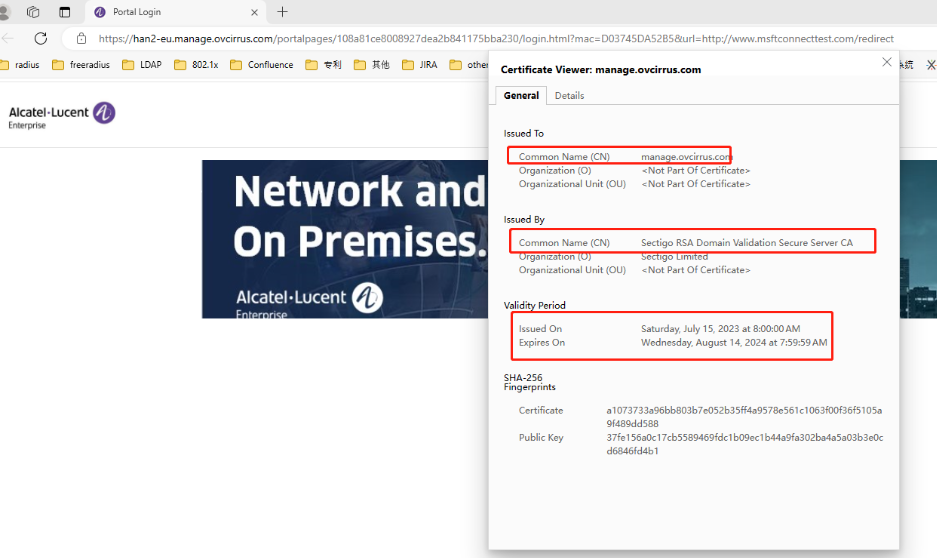
Captive Portal Screen Displayed on Microsoft Edge (OVNG-13528)
Summary: When a guest device using a Microsoft Edge browser opens the Captive Portal Template after connecting to an SSID, the sign in/sign up form may not display (no username, password input shown). If this happens, there may be a mismatch between the hostname the Web browser is attempting to reach and the hostname sent by the Web server in a digital certificate.
Workaround: Click the Lock → Connection is Secure → Certificate Icon on the browser to check if the certificate is correct. For example:
Wireless
Mesh Topology and Topology Do Not Show Links for AP Bridge Connections (OVNG-22977)
Summary: When you configure an AP as an AP Bridge (either Root or non-Root role), the links for AP Bridge connections are not displayed in the Mesh Topology or Topology applications.
Workaround: There is no workaround at this time.
AP does not Send “portal.report” Event when Wrong Username/Password Entered (OVNG-2811)
Summary: When a user logs in to UPAM Captive Portal with an incorrect username/password, the login will fail but the failure is not immediately indicated on the QoE Analytics UI. Only after 15 minutes will QoE report the failure and the failure is reported as a “Timeout”. Two consequences of this are: Users won’t find out about the failures to login to UPAM Captive Portal until after 15 minutes, and the user will not be able to differentiate between a true “Timeout” with UPAM Captive Portal versus wrong credentials entered at UPAM Captive Portal login.
Workaround: No workaround at this time.
"HostName" Information Lost in “user.report” After the Client Roams to Another AP (OVNG-7792)
Summary: The Client Name (aka “HostName”) information in WLAN Client List is lost after the client roams to another AP.
Workaround: No workaround at this time.
AP Client is Assigned to Untagged VLAN Instead of Tunnel ID Configured in Access Role Profile (OVNG-11683)
Summary: When an Access Role Profile (ARP) with Tunnel only mapping is applied to an AP client, the client is assigned an IP Address in the Untagged VLAN network, not an IP address in the Tunnel network.
Workaround: No workaround at this time.
Issues Fixed
PRs Fixed Since Release 10.5.2
-
Error Occurs When Accessing/Deleting an Organization (OVNG-22976)
-
It Takes More Than 45 Minutes for a Client to Appear on the Application Visibility Widgets Page (OVNG-19911)
-
Schedule Upgrade Using Set Desired Software Version (OVNG-10325)
-
Cannot Enter Another Username/Password in Terminal Session Modal (OVNG-14678)
-
Manual Rediscovery Does Not Update All Objects Changed on Switch (OVNG-17911)
-
Unified Access Profiles in Pending Status After Upgrade to OmniVista Cirrus 10.5.1 (OVNG-21343)
-
BYOD Self-Service Login Page Account Password Rules and the Account Password Rules Are Inconsistent (OVNG-22726)
-
Cannot Edit an AP Web/External CP Certificate if Name Contains a Dot (OVNG-23397)
-
Each AP Group Can Only Support Up to Seven SSIDs (OVNG-9610)
Customer PRs Fixed
-
If Message-Authenticator verification fails, the authentication failure reason is displayed incorrectly as "Unprintable Password" instead of the actual cause.(CRNOV-7838 OVNG-23139)
-
OVNG Display wrong client roaming history showing client connected to 2 different AP at the same time (CRNOV-7920 OVNG-24700)
-
OVNG Web Page delay and latency issue ( CRNOV-8210 CRNOV-8135 CRNOV-8134 CRNOV-8118 CRNOV-7629 OVNG-21185)
-
OVNG user should be able to fetch traps from a switch (CRNOV-8128 OVNG-21904)
-
Employee Account / Guest Operator: show hidden password is wrong in the Edit page (CRNOV-8099 OVNG-23485)
-
Unable to map the ports to the VLAN via OVC 10 (CRNOV-8277 OVNG-25640)
-
Issue with SSO for login to OVNG via Entra ( CRNOV-8270 OVNG-26000)
-
Improve error message for Access Policy limit (CRNOV-7951 OVNG-24595)
PRs Fixed Since Release 10.5.1 Patch 1
-
Unable to add static neighbor for AP (OVNG-23562)
Customer PRs Fixed
-
Cannot import company property from CSV or XLSX. (CRNOV-7494 OVNG-21709)
-
Unable to search the RF profile details. (CRNOV-7604 OVNG-21903)
-
The username with "space" in captive portal guest account is not working if it is created using self-registration strategy. (ALEISSUE-2249)
-
Unable to modify SSID parameters after update 10.5.1. (CRNOV-7632 OVNG-22034)
-
Issue with License Release when deleting Floor/Building. (CRNOV-7635 OVNG-21962)
-
Reset UPAM/Email templates after customization. (CRNOV-7600 OVNG-22821)
-
OmniVista should allow user to delete Incremental/Value mapping template that was not used. (CRNOV-7375 OVNG-22906)
-
Notify When Access Role Profiles Are Removed from Switches. (CRNOV-7621 OVNG-21933)
-
License utilization is showing incorrectly in OmniVista. (CRNOV-7500 OVNG-21556)
-
Unable to SSH the switch from OmniVista with 3 letter usernames. (CRNOV-7495 OVNG-21774)
-
There's a typo error in the External Captive Portal Template. (CRNOV-7852 OVNG-22951)
PRs Fixed in Release 10.5.1 Patch 1
-
Cannot Import a Flexible Pay License (OVNG-21421)
-
License Management > Manual assignment behavior (Step 2) differs during license import vs License Management (OVNG-21544)
-
License Status Information Count is Incorrect in Org List, Default Dashboard, and License Management (OVNG-21210)
-
Automatically assign licenses are disabled when clicking F5 (OVNG-21486)
-
"Do you want to automatically assign licenses to any new device added to the Device Catalog?" When you enable by clicking “Yes” (during import license), it initially appears to be enabled but switches back to “No” after the license upgrade. (OVNG-21533)
-
When you click on the device Friendly Name in the Alerts list, the Device Details screen opens with the following error message: “The requested source does not exist” (OVNG-21453)
-
Alerts not displayed in the Alerts table when the “Group by Window” option is not set to “none” (OVNG-21324)
-
Alerts are not displayed for Organization Limited Admin and Viewer user when the Organization scope filter is applied (OVNG-21461)
-
When editing a Unified Policy List with AOS and AP Group change, the AOS device is not updated (OVNG-21465)
-
Unable to SSH to the switch from OVC 10 with 3-letter usernames (OVNG-21539)
-
Error message “The requested source does not exist” displays when you click on Create Access Classification (OVNG-21456)
-
Changes made in Edit IP interface screen for device type IPIP tunnel and GRE tunnel are not reflected in the UI and AOS (OVNG-21433)
-
Unit in “Upload Bytes distributed by Top 10 Connection Mode” and “Upload Bytes distributed by Top 10 SSID” is not correct in “Client Summary Report and Client Health Report” (OVNG-21355)
-
The Custom Attributes value of the Guest Account is not visible in the UI after registration (OVNG-21025)
-
Guest Account addition failed (OVNG-21184)
-
Cannot import Guest Accounts after creating one manually (OVNG-21468)
-
Missing Service Level / Registration Profile attribute when creating Guest Account (OVNG-21420)
-
Export of Guest Remembered Devices data fails (OVNG-21313)
-
When the "OmniVista Advanced Analytics" switch in the Provisioning Configuration is turned off, the AP mdps process does not exit (OVNG-21153)
-
The “Copy whole content to clipboard” option for the Golden Configuration is not working (OVNG-21416)
-
When you disable “Mesh/Bridge Configuration”, only the “Mesh/Bridge Configuration” parameter changes (OVNG-21229)
-
IOT failed to start in EU Prod after production upgrade (OVNG-21609)
-
EU Prod 10.5.1 ovng-lan, two instances crashed 3 times due to webview error in content of ext_ov_lan_mqtt_src_aos_ip_interface_info_incoming_messages (OVNG-21703)
-
OVC 10.5.1 backend fails to connect to datapond due to expired token (OVNG-21462)
-
The Actions button does not display on the AP Details screen (OVNG-21815)
Issues Fixed Since Release 10.4.3
Customer PRs Fixed
-
Management connectivity status is OFF for AOS switch (SR # 00807386 CRNOV-7152)
-
OV Cirrus Account Activation Failure due to time zone mismatch (SR # 00810183 CRNOV-7191/OVNG-19901)
-
AP stuck in calling home in hash mode with FailedToGetCertificate status when onboarding to OmniVista Cirrus (SR # 00816825 CRNOV-7318/OVNG-14879)
-
AP Friendly Names Reverting to Default (AP-XX:XX) (SR # 00820756, 00821852 CRNOV-7334/OVNG-21004)
Release Note Issues Fixed
-
If the SSID Name in a “aproqueinfo.report” Contains a Semicolon, WIPs Alerts and Analytics are Not Generated (OVNG-14205)
-
Need to Wait One Day After License Renewal to Add Devices (OVNG-14988)
-
Error Message When Filtering Auth Resource Column in Authentication Records List (OVNG-15414)
-
Incorrect Event Responder Information When Device is Moved to a Different Site (OVNG-15663)
-
Link on the Topology Map Is Lost When the Switch Goes Down (OVNG-14922)
-
CSV Analytics Report File Displays More Fields Than the Created Report (OVNG-15429)
-
Completed Wired Client Sessions Not Shown After Device is Deleted (OVNG-15250)
Issues Fixed Since Release 10.4.2
-
Start/End Date Values Not Shown When Editing a Report with a Custom Date Range (OVNG-14672)
-
Cannot Edit a Tunnel Profile with “%” or “+” in the Profile Name (OVNG-15410)
-
Creating/Editing Unified Policy With Allowed Special Character Does Not Always Work (OVNG-15415)
-
Save Disabled When Editing the Responder Status (OVNG-15530).
-
Auto-Group VLANs Fails to Apply a New Profile to an AP (OVNG-15351)
-
Limitation When Selecting an Existing Group for a Unified Policy Condition (OVNG-10690)
-
Limitations for Deleting Unified Access Profiles on AOS Switches (OVNG-17942)
-
All of the Special Characters Not Allowed in Unified Policy List Name are Not Specified (OVNG-15404)
-
Data VPN Setting With Shorthand Mask IP Address Ending in Zero Fails (OVNG-15394)
-
Rogue AP Cleared Alert Is Not Generated if Organization Status Is Update Requested (OVNG-14906)
Issues Fixed Since Release 10.4.1
-
Current Client Density Screen Displays Incorrect Session Start Time for AP Clients (OVNG-11243)
-
AP Location is Empty in Live Wireless Client Additional Information (OVNG-12164)
-
Editing the AP Device Location Disrupts Connectivity With the AP (OVNG-12252)
-
Mismatch Between Time Filters on the Client Analytics Screen and the Clients Screen (OVNG-12257)
-
Service Temporarily Unavailable Message With External RadSec Server (OVNG-11277)
Issues Fixed Since Release 10.3
-
PKSC8 private key is not supported for LDAP cert and AP Web Cert (OVNG-7726)
-
False Portal Authentication Failure Alert Messages Received (OVNG-11239)
-
Current Client Density Screen Displays Incorrect Session Start Time for AP Clients (OVNG-11243)
Additional Documentation
Online help is available in OmniVista Cirrus and can be accessed by clicking on the Help Link (?) in the upper-right corner of any screen. You can also search through the online help on the OmniVista Cirrus Documentation home page to familiarize yourself with OmniVista Cirrus 10.5.2 features and functionality.
Technical Support
Alcatel-Lucent Enterprise technical support is committed to resolving our customer’s technical issues in a timely manner. Customers with inquiries should contact us at:
Region Phone Number
North America 1-800-995-2696
Latin America 1-877-919-9526
Europe Union +800 00200100 (Toll Free) or +1(650)385-2193
Asia Pacific +65 6240 8484
Internet: Customers with Alcatel-Lucent service agreements may open cases 24 hours a day via Alcatel-Lucent’s support web page at: https://myportal.al-enterprise.com/.
Upon opening a case, customers will receive a case number and may review, update, or escalate support cases on-line. Please specify the severity level of the issue per the definitions below. For fastest resolution, please have telnet or dial-in access, hardware configuration—module type and revision by slot, software revision, and configuration file available for each switch.
Severity 1 - Production network is down resulting in critical impact on business—no workaround available.
Severity 2 - Segment or Ring is down or intermittent loss of connectivity across network.
Severity 3 - Network performance is slow or impaired—no loss of connectivity or data.
Severity 4 - Information or assistance on product feature, functionality, configuration, or installation.